When we went overland from UK to Kathmandu in the early 1970s we encountered many people who were part of a sort of sub-culture that existed at the time. Flower-power was still around; long hair, a different way of dressing and drugs indicated membership of the group and rejection of many of society's long standing and boring conventions. In Kathmandu in the 1960s a street was re-named and dedicated to these people; Freak street is still there today, forty years later. Were they freaks?
During our travels we tended to keep the most radical of these people at arms length. We had already finished with all of this and had completed education, embraced employment and had a sort of plan for the future.
In recent years, when looking back via web-sites and publications about the period and about 'the hippie trail' we can see that many of our fellow travellers developed into serious members of society, some in professions and in senior positions. Also, looking back and comparing, however radical the ideas and behaviour was considered to be at that time, it's clear that we were no threat, quiet and considerably less troublesome than some of the 'freaks' that are nowadays found in parts of UK towns and cities at the weekends around pub and club closing time.
End of rant, please read on,
|
We left the UK in the summer of 1973. We had been married two years and had been talking for several years about a trip to India and Nepal as soon as we had finished College. We had saved for a few years and had around £800 to our name. We bought open date tickets on Air India from Delhi to Manchester at a cost of £80 each. We took £250 in travellers cheques and left the balance in the bank in UK.
We had read all the books; The Road to Kathmandu by Patrick Marnham, Full Tilt by Dervla Murphy and books by Eric Newby. We packed rucsacs and got a lift by road across Europe in a Bedford van. I actually did the driving and we passed through most of Europe into Austria, Yugoslavia and Bulgaria and into Turkey. It was in Eastern Turkey that we parted company with our lift and got onto public transport. We crossed the border at Bazargan into Iran. |
 |
There were a surprising number of young people in the small town of Bazargan, all heading east. Some of them had nothing more than an M&S plastic bag as luggage. Every day there was a new batch of 30 or 40 waiting for the afternoon bus to Tabriz and Tehran. There was a great exchange of information about routes and transport and hotels and visa requirements. This was when we really started to find out about how to travel overland to Asia.
We were all decanted from the bus at a traffic island somewhere in Tehran in the middle of the night and made use of the information received from fellow travellers and found a hotel. In the morning everybody went to the railway station where there were many faces from the bus and many new faces, buying tickets to travel across Iran to Mashad.
We took a few days going across the top of Iran and we got Afghan visas in Mashad. Mashad was where the public transport sort of ended and from Mashad to Taybad at the Afghan border was by whatever local transport, including donkey carts, was available.
|
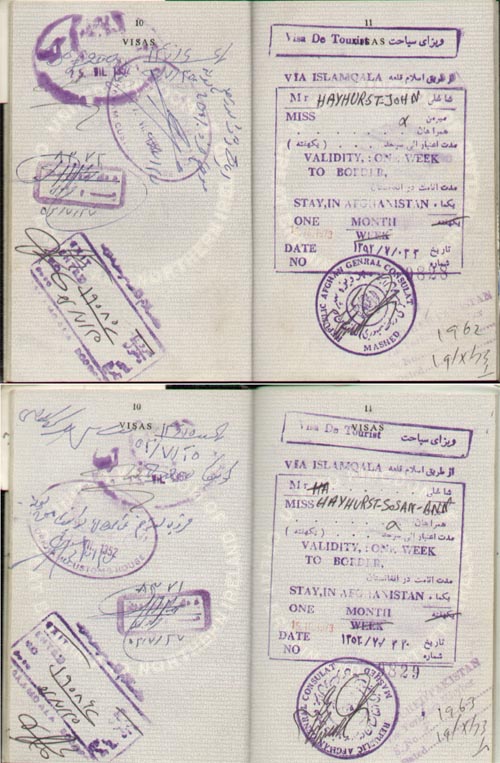
Getting into Afghanistan was a one-day task. There was no formal fence, barrier or border crossing. It was just an assortment of 'places' you had to go, all on the same patch of open ground. There were desks out in the open, there was a tent. There was a small octagonal tin hut, the sort of temporary building you might see on a building site; bolted together rectangular sections for the walls and triangular sections formed the roof. There was a large two-storey Victorian style house that looked like something from a Hitchcock movie all on it's own in the sand. We just moved as instructed from one to the other and waited and moved again. It was getting late and looked like we would be on this patch of desert all night, then finally we had all the necessary and we were in Afghanistan. Click on the visa picture for bigger image.
|
 |
One of the problems was that there was no public transport of any sort in Afghanistan. There were local buses but generally, travellers like us looked for an alternative. We came across three Bedford bakers vans from England, they still had the sign writing on the side and were full with Pakistani families who were travelling for holiday in their villages in Pakistan.
They were having trouble with one of the vans, we managed to arrange a lift but I had to fix the van and then drive it through Herat and down to Kandahar and up to Kabul. We stayed in a hotel in Kabul and then drove to the Pakistan border.
The road from Kabul to the border mostly follows the route of the Kabul River. Through narrow gorges where the river descends rapidly as a white torrent and across wide flat plains where the river spreads to a very wide and quiet body of water almost like a lake. Certainly some of the most spectacular scenery in the world, but this is a wild place with the hills and mountains above you (now infamous as Tora Bora) and the tribal areas of Waziristan and the NWFD to the left. The Pakistan border town is called Torkam, it very much a frontier town and had some suggestions of Kipling and the British Raj. It was late afternoon when we arrived in Torkam and by the time we had got through the immigration formalities, the Khyber Pass was closed. It closed from sunset to sunrise every day. The Khyber Pass has some spectacular scenery and it was interesting to see that the various regiments that had served there had left their cap badges carved 8 and 10 feet high in the rocks at the roadside.
We parted company with our baker's vans in the city of Peshawar and we now had the great Indian railway system available to us. We bought tickets from Peshawar to Lahore and broke our journey half way at Rawalpindi. We had met a guy on the train who was the chief clerk at the Star Brewery in Rawalpindi and he urged us to stay at his brother's hotel and visit Rawalpindi and Islamabad. We remember well the visit to the brewery, which presumably now is no longer operating.
After a couple of days we boarded the train again and went down to Lahore to investigate how we were going to get into India. Pakistan and India were at war at the time, so although we had useful information from our fellow travellers we were a bit concerned that this might be difficult. In fact it turned out to be very easy, except that we had to walk a couple of kilometres across no-mans-land at Wagga. The Pakistanis were very anxious to be of assistance and to see us off properly ensuring that we left with a good impression. The Indians were waiting at the other side to welcome us and equally anxious to give a good impression.
We took the train from the border down to Amritsar and then on to Delhi. We spent several weeks in Delhi living in hotels in Pahar Ganj, known locally as the Beggars Bazaar, immediately opposite New Delhi railway station. We were paying approximately 50 to 75 pence per night for a room and we were eating in the local restaurants which cost us about 50 pence a day. We travelled around Delhi on foot and using the auto-rickshaws, visiting the tourist places.
We were in Delhi during Diwali. Pahar Ganj during Diwali is not a place for the faint-hearted. Diwali is known as the festival of lights but it is also an opportunity to let off homemade fireworks.
The most simple of these devices is a spherical clay pot about 6 or 7 inches across and packed full of homemade explosive. They have a short funnel sticking out with a fuse that fizzes, cracks and sparks when lit. They are exactly the same as can be seen in the best comic books and cartoons.
Young boys run around the bazaar lighting these things and placing them under market stalls. Warnings are shouted and people run in every direction. There is a tremendous explosion and possibly part of the stall may collapse. This is all followed by shouting and cursing. Apparently it’s great fun.
There are also rockets that wiz around the bazaar at very high speed and right at the end of their flight they finish with a very sharp, loud explosion accompanied with a bright flash of light. These things don’t go in a straight line. They constantly change direction up, down, left and right. Sometimes they turn through 180 degrees. We saw one zip over a balcony rail and through the open door of a first floor hotel room. There was a bright flash and sharp explosion, seconds later a Japanese tourist appeared on the balcony waving the smoking remains of the rocket above his head. He was forcing a smile and feigning support for the festivities, one suspects however, that it was several days before he could eat or sleep properly.
|
Eventually we carried on our journey by rail across northern India to Kanpur, Lucknow, Alahabad and Muzaffarpur, until we reached the Nepal border at Rauxal. Here the railway line ended and we had to find transport over the hills into the Kathmandu valley.
We were told the best way to do this was standing up in the back of a truck, and we saw some people who had taken this option. We decided against it and got tickets on a bus. It was a full day trip during which the bus climbed to several thousand feet before starting its descent into Kathmandu. At the side of the road, you could see a cableway which carried flat pallets containing goods up over the hill to Kathmandu. I wonder if this thing is still working. |
|
We spent several weeks in Kathmandu.
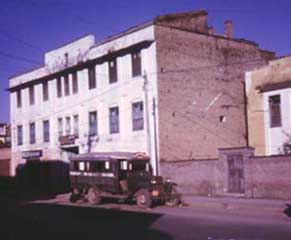
There were only a very limited number of first class hotels, not that we were looking for those, we were staying in "Super Lodge" which was the other side of Ratna Park. The building behind the old bus in the picture is Superlodge.
There were no shopping centres or anything like that. I understand that now there are even supermarkets with escalators and serious traffic congestion in the city. There is even a new Yak & Yeti Hotel. When we were there we visited the original Yak & Yeti, which was still being run by Boris of Kathmandu. The place was straight out of the Raj and starting to fall apart, there was talk about this new tourist hotel, but I think to us at that time, it seemed a long time off. |
|
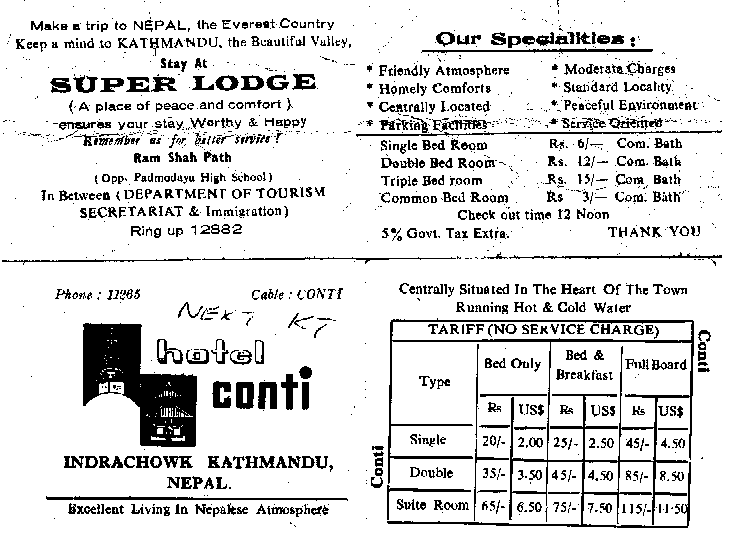 |
On the left are copies of the cards from Superlodge and Hotel Conti. Click on the image to see a bigger version and also the reverse sides of the cards where the tariffs are shown. Remember that at the begining of the 1970s the exchange rate was less than 20 Rupees to the Pound.
Minced Buff and Mash was the right price and available at most local eating places. There was a restaurant half way up New Road that we used sometimes, and many evenings we used the Swiss restaurant where it was invariably Weinershnistel (probably thinly sliced Buff) followed by Swiss-roll. Aunt Jane's American Restaurant was very popular, it had been started by Jane Martin who was the wife of an American Peace Corps Worker. Aunt Jane's was located on Freak Street and the specialties included Sloppy-Joe (Minced Buff on an open Hamburger bun) and Chocolate cake with peanut ice-cream. Jane Martin had started the restaurant because she thought it was essential to provide the young backpackers good wholesome affordable food, and thereby reduce the need for them to use the cheap back-street places with the associated hazards. If you had been in Kathmandu for some time and if you had been a regular customer at Aunt Jane's you could claim a free meal before your departure. |
|
Most of our days were spent wandering around the city. We often went to the central post office to go through the 'Poste Restante' section. It was a separate part of the post office where you just asked for the 'H' for Hayhurst bundle and then went through to see if there was anything for you. Standing on the top step of the post office and looking out and slightly to the right was one of the few places in the city from where you could actually see Mount Everest.
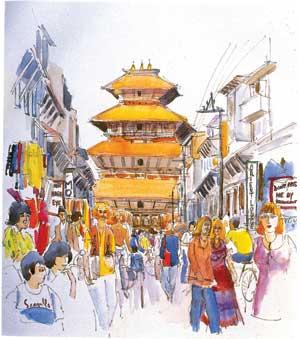
Temple Square and the Hanuman Dhoka was a popular hang-out. I understand that now things have become so crowded that an entry fee is charged. If you passed Kumari Ghar, the home of the living goddess and entered Temple Square, diagonally opposite in the corner of the square was a small shrine of Ganesh, behind the shrine a narrow alley went down, this was pig alley.
|
|
|||||||
The way to get around Kathmandu was by bicycle. We went along to one of the small rentabike shops. Neither of us had ridden a bicycle for a few years. Susan particularly wanted one with a good loud bell. She tested all the bells till she found one suitable.
We went out into the narrow streets and bazaars, me in front and Sue following. It was like being 10 years old again, weaving around the people. I could hear the constant 'ring ring' behind me and Sue shouting 'look out', 'excuse me', 'hey-up'.
We were getting more confident and seemed to be doing well then the 'ring ring' became sort of frantic. I heard 'Hey-up, oh shit!' and a thump and smash sound. I looked behind and saw a heap on the floor. A Nepalese businessman, smartly dressed in jacket, traditional Nepalese cap and jodhpurs was sat in the middle of the street. He was clearly bewildered and was looking up at the buildings in front of him, he seemed convinced that someone on a balcony had thrown a bicycle at him. Then suddenly he became aware that he was sharing the wreckage with an Englishwoman. He started apologising and began to disentangle himself. Still apologising, he lifted the bicycle upright and helped Sue to her feet. He continued to apologise and even bowed slightly as he hurried away down the street.
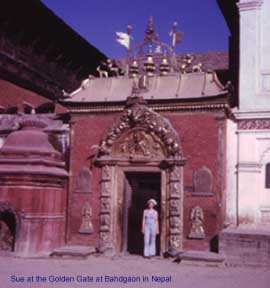 |
We cycled to Bhadgaon which is a historic town in the Kathmandu valley. It was quite a distance. On the way there Sue seemed a bit slow and on the way back she asked me to check her bike to see if the brakes were dragging. I could find nothing wrong with the brakes but the bike was tight; even going downhill if you didn't pedal it would stop. It was several days before Sue recovered and her leg muscles loosened up so she could walk comfortably. |
|
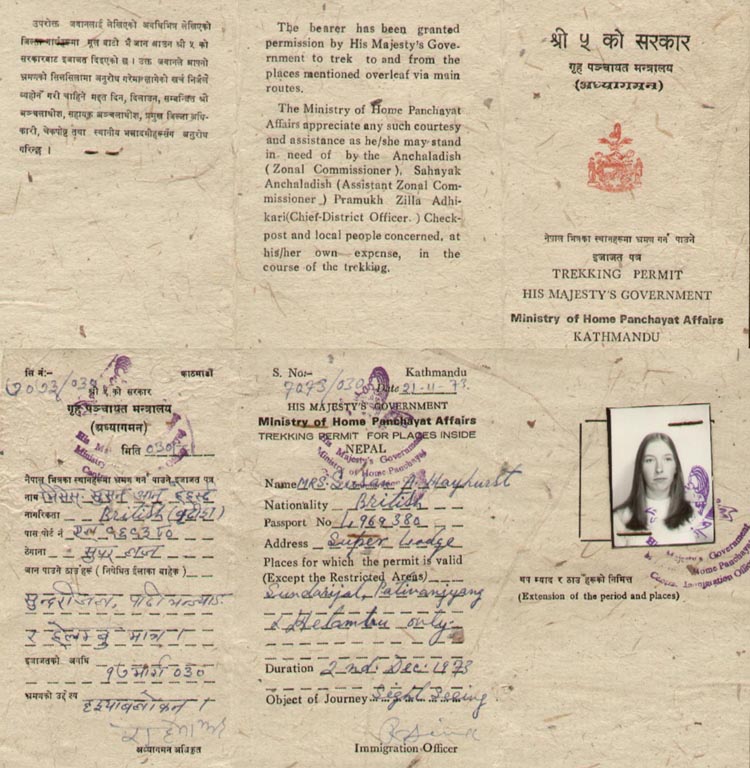
We travelled through Nepal by bus to Pokhara where there is a mountain lake. We stayed several days in Pokhara which is overlooked by Annapurna, Machapukare and Dhalgiri mountains. You could rent a hollowed out log on the lake and paddle around in circles. Circles were the only way you could go because the logs were all bent! The lake was totally still and the only sound you could hear were the bells from the monastery on the mountainside. Click on the picture for a bigger view of the permit.
The photo on the permit is Sue in her long-hair road-to-Kathmandu phase, click here for a bigger view.
|
 |
All over India and Nepal 'Codds' bottles were in use.These are fizzy drink bottles, invented in 1872 in Salford by a man called Codd, and have a specially shaped neck containing a rubber seal and a glass ball. It's interesting that Codds bottles are regularly dug-up on building sites in UK and are treated as curiosities. If the rubber seal is gone, the ball will probably not be there, so many people in UK look at them and don't know how they work. The pressure of the fizzy drink holds the ball up against the seal, the waiters in local restaurants carried a wooden peg on their belts and used it to 'open' the bottle by knocking the ball down. They then tipped the bottle and twisted it to catch the ball in the neck while the drink was dispensing. It was in the country lanes of Pokhara that we came across a family using a modern, purpose-built, bright stainless steel tipping contraption to fill Codds bottles. On UK TV these bottles sometimes turn-up on shows like Bargain Hunt and Antiques Roadshow and people would probably be surprised to know that somewhere, they are still in daily use.
Pokhara was a wonderfully peaceful place, the only excitement was the daily coming and going at the airstrip. It was a grass strip and for some reason had been positioned across the valley. Everyone sat on the grass looking up the valley towards Kathmandu to see who could be first to spot the plane. As soon as the plane was seen a loud horn sounded and a small team of locally recruited boys rushed onto the strip to clear the cows and other livestock. The plane came down the side of the valley, tipped on it's side and dropped quickly onto the airstrip.
It was an old Dakota with the third wheel under the tail so passengers embarked through a side door at the back and then walked uphill to find a seat. There might have been thirty or forty seats but there were never more than ten or a dozen passengers.
We booked tickets a couple of days in advance for the trip to Kathmandu. We had been several times and observed the arrivals and departures so on the day we made our way casually and unconcerned through the country lanes to the airstrip. When we arrived there was an unusual amount of activity. To our horror an Indian movie crew were leaving on our plane! There were more passengers than seats and we briefly considered delaying our departure, however, the airline staff assured us our seats were confirmed and it was just a case of deciding who among the film makers would be left behind.
Small doors under the plane were opened and the spaces filled with heavy boxes of film making equipment and film-stars luggage. The passengers got on and you cannot imagine the hand-luggage that these people were carrying. We took our seats and we could feel that this aircraft was heavily loaded.
The pilot took the plane right up the airstrip and swung it around with the tail just missing the bushes and the broken fence. It was clear from the grass and the uneven ground that the plane hadn't come this far back for a long time. The engine raced and the plane shook and the pilot released the brake and we bounced down the field. We travelled most of the length of the field before we were finally off the ground. Off the ground, but only just off the ground and we were still heading for the mountains on the side of the valley, at what seemed like the last minute, the pilot tipped the plane and we turned up the valley towards Kathmandu. Flying through the Himalayas was a wonderful experience.
We spent a few days in Kathmandu and considered our return trip to Delhi. We decided we could afford another airplane trip out of Kathmandu. Patna and then Indian Railways to Delhi was the cheapest alternative. Bihar always has been one of the poorest of Indian states and Patna has never been on the tourist trail so we were something of an event.
There was nothing at the airport and we needed to change some travellers cheques. We got the details of a bank and needed transport. We ended-up in a sort of horse drawn cab. The bank was in the centre of town and didn't look very impressive, when we entered everything suddenly became quiet and everyone turned to face us. Eventually a bank employee stepped forward and was clearly hoping to establish as early as possible that we were in the wrong building. We explained that we wanted to change travellers cheques. After a few minutes of discussion the centre of the bank was cleared and a large table and several chairs were set out. We sat at one side and the manager and his advisors at the other.
While the bank team studied our documents, we were able to have a look around the bank. There seemed to be a surprising number of employees, some sat shoulder to shoulder behind counters, others were at slightly elevated desks. Just above head height there was a series of wires arranged in pairs about six inches apart, running this way and that across the bank. Little tin trolleys were on each pair of wires and by using levers at each end, the trolley could be pulled against a spring, loaded with documents and then shot across the room.
There are many examples of this type of old technology that is kept alive and working throughout India and Nepal. It's interesting for us but it's also a credit to the ingenuity of the Indians and their waste-nothing philosophy.
In many ways this back-to basics technolgy is very useful to India. A good example is the Ambassador car. It's a 1950s Morris Oxford with leaf-spring suspension, the old 'B' series BMC engine and an electrical system based on a dynamo and two-coil cut-out/regulator control box. Spare parts are available in every village and at the side of every road you will always find someone with a box of spanners and a good understanding of the machine.
We flew from Delhi back to the UK just in time for Christmas and with enough time to pack for our departure to Zambia at the beginning of January.